Tony Leon draws on Martin Niemöller’s First They Came, warning that the country’s decaying institutions, political ambivalence, and rising anti-immigrant mob justice are creating a dangerous echo of the scapegoating and silence that enabled atrocities elsewhere.
The renewed festival of hate against migrants in South Africa is a timely reminder of the famous 1946 prose of German Lutheran pastor Martin Niemoller titled First They Came.
Niemoller was a one-time supporter of both Hitler and the Nazi Party. He evolved into an opponent of the regime and was imprisoned for the last eight years of the Third Reich, from 1937 to 1945.
The complicity of silence across much of German civil society, and especially the churches, was distilled in Niemoller’s post-war confessional.
First they came for the socialists, and I did not speak out – because I was not a socialist.
Then they came for the trade unionists, and I did not speak out because I was not a not a trade unionist.
Then they came for the Jews, and I did not speak out – because I was not a Jew.
Then they came for me – and there was no one left to speak for me.
Happily, South Africa today is not Nazi Germany. But it certainly bears the scars and signs of a stressed democracy characterised by institutional decay, rising populism, and an incapacitated state.
And citizens here, who enjoy the constitutional protections, have a duty to speak out against those who would destroy essential freedoms and deny them to the most vulnerable, including those who don’t look like us or even speak our language.
It is a sign of democratic health that there’s a fierce public debate around immigration and the proposed “March and March” 30 June deadline for all “undocumented” migrants to be thrown out of the country. Or risk a “national shutdown”.
Less healthy are the threats themselves, the unchecked mob that makes them and those who lead, unindicted to date, the forces of disorder. They point in another darker direction.
And we have all been in this bad movie before, and we all know what this means and where it leads.
Long before the police here were mired in leadership failures, infested at the highest levels by criminals and grifters, and the economy was growing at four times its current rate, we saw the hideous face of unchecked xenophobia.
That was back in May 2008. Sixty-two people were killed in an orgy of violence targeting foreign nationals. Though in the indiscriminate mayhem, 21 South Africans were among their number, mistaken for foreigners or belonging to minority ethnic groups, according to one report. So, when the current organisers of the anti-immigrant agitation advise that their target is only “undocumented migrants”, we have an idea and a grisly precedent of where this ends.
In 2008, Thabo Mbeki was president. He called out the violence as an “absolute disgrace” and “savagery” and invoked national unity and reminded citizens of the support received from other African countries during the struggle.
Yet, famous denialist as he was, he refused to accept that there was an anti-foreign sentiment. He later said, “What happened during those days was not inspired by … mindless hatred of foreigners – xenophobia.” That probably wasn’t correct then, and it certainly is not today.
Mob in charge
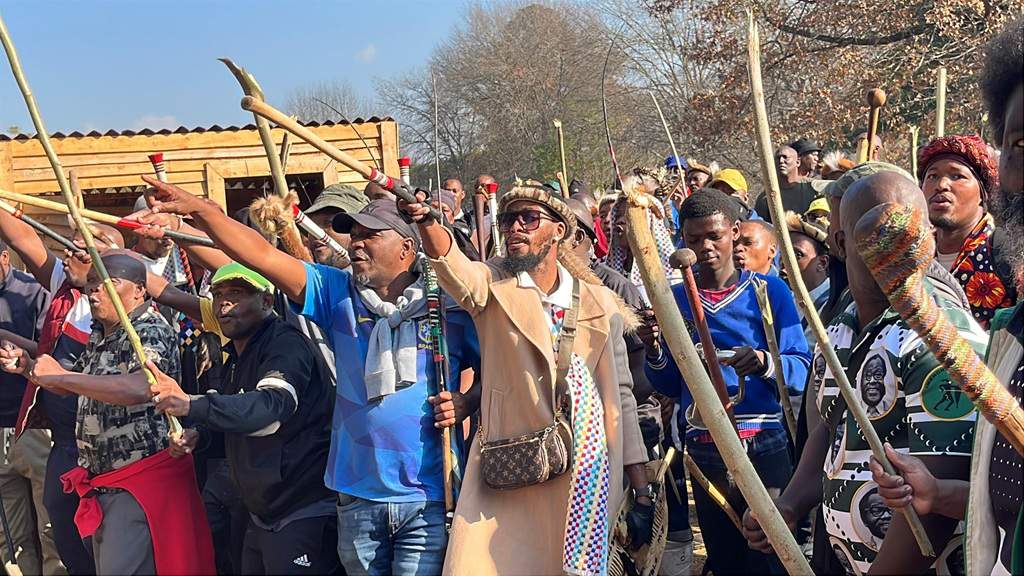
Now we have vigilantes going around and demanding proof of lawful residence. One commentator noted that it is eerily reminiscent of the days of “dompas”, though in this case it is the mob, not the law enforcers, who are in charge.
Thus, the baleful shadow of Niemoller’s warning on scapegoating, weaponising, threatening and killing targeted minorities lives anew in our constitutional republic.
And the state itself? Not quite Weimar, which was unable to protect itself against the extremists who plotted the downfall of democratic Germany in the 1930s. But ours is certainly both hollowed out and weak in response to credible threats by anti-constitutionalists who misuse the public space to plot against public order.
Our state is broken-backed. Charged by the Constitution to protect citizens (and non-citizens) from unlawful harm and danger, it has the twin tasks of enforcing immigration rules and the state itself against violent insurrectionists.
What we are witnessing as we barrel toward 30 June is a multifront failure.
How many illegal foreigners are in SA? Who knows? How many are awaiting outcomes of lawful processes to determine their residency? At the very least, despite the recent clear-out of historic backlogs, thousands still await outcomes of visa, waiver and appeal applications. Such fine legal niceties will matter little to vigilantes demanding a clear-out of all the “undocumented” in one week’s time.
Ian Cameron, MP, chair of the parliamentary police committee, recently warned: “Hollowed-out SAPS leadership a danger to the nation.” Citing the horror show on daily display at the Madlanga Commission, he welcomed its exposé but then noted, “Yet as has become all too common in government, urgency is absent and decisive leadership is absent.” Indeed: the top current law enforcement leadership is either under investigation, suspended indefinitely or “merely occupying temporary positions”.
And he also cited a fact obvious to most, barring our political masters: “Public confidence is not built through press statements, constant reassurances and slogans.”
Statements, reassurance and slogans
This was precisely what SA received on the eve of the July 2021 looting and rioting in KwaZulu-Natal and Gauteng, the so-called “Free Zuma” protests. Three hundred and fifty people were killed at an estimated R50 billion cost to the economy. The state issued reassurances. The police initially were hapless bystanders. Private security and armed citizens filled the yawning gap of an enfeebled state.
Yet, again this week, we got the Camerons’ “triple-press statements, reassurance and slogans” when acting Police Minister Firoz Cachalia and his colleagues addressed the media on Monday. Cachalia declared, “Criminality, violence, the destruction of property and any attempt to undermine public safety will not be tolerated.”
That is a fine statement of constitutional respect and public reassurance. We will know next week whether, this time at least, the state’s deeds match the state’s words. Will it do next week what it failed to do in 2008, or again in 2021, is the urgent question. We will know the answer soon.
Stirring up sentiment
And the double-speak and ambivalence of some national political leaders aggravate a flammable situation. You hardly need to be Herman Mashaba or Jacob Zuma or even Gayton Mackenzie to know that stirring anti-immigration sentiment can buy a lot of support. Cue here, Donald Trump, Nigel Farage and Marine Le Pen.
In more sophisticated terms, there was President Cyril Ramaphosa’s address on the topic. He tried the straddle. As NGO Kopanang Africa Against Xenophobia wrote in the Daily Maverick, “[While] the government publicly condemned xenophobia and cautioned against blaming migrants for South Africa’s social and economic difficulties, it continued to frame migration as a central explanation for challenges that are fundamentally rooted in governance failures, economic stagnation and institutional decline.”
In other words, lean into the anti-migrant rhetoric of others, but defang its violence and crudity. And don’t accept presidential or personal responsibility for the multiple governance failures that are both cause and symptom of the 30 June showdown.
SA is not alone in blaming the “outsider” as a useful scapegoat for failure – personal and political. The word “pogrom” owes its origins to Russia under Czar Alexander III. It translates as “thunder”. Violent mobs were unleashed in Russia against the most marginal group in the empire, in that case, the Jews.
Author Gabriel Gatehouse wrote last weekend in the Financial Times: “Alexander III discovered that pogroms were a useful tool to deflect anger away from himself and the establishment and protect the old order.”
That was in the 1880s. One hundred and forty years later, we are reminded that “history doesn’t repeat itself, but it often rhymes”.